Posts

Showing posts with the label PowerApps

All you need to know about Microsoft 365 formally known as Office 365
Image
  As a product line, Microsoft Office dates back nearly three decades, with early versions essentially combining Word, Excel, and PowerPoint into a discounted bundle. Microsoft 365 (previously known as Office 365), which has been available since 2011, differs from that old-fashioned bundle in two respects: First, it's sold as a subscription (billed monthly or yearly), rather than as a perpetual license with a fixed one-time payment. Second, it combines a suite of online services, including business-class email, cloud file storage, and secure communication tools along with the traditional desktop apps. Because it's a subscription offering, those desktop programs are updated automatically when a new version is available. If your subscription is current, you get the latest versions, with security releases monthly  and feature updates every six months, on the same calendar as Windows 10. Microsoft 365 is available in Family and Personal editions (previously known as Office 36...
How to maximise your existing Office 365 infrastructure as part of your digital transformation

Image
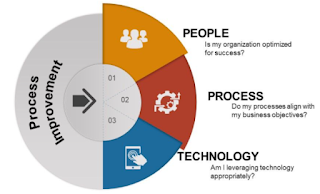
How can it help you maximise the use of existing infrastructure and investment – specifically Office 365 and MS Teams, to address your current challenges and accelerate your journey to get to the next level of Digital Maturity Model of engagement  To explain that, lets first look at the traditional method of developing and delivering systems without delving too much into the different methodologies. Typically, the business would capture their requirements, and then decide to build (develop and validate) or buy (select and off the shelf application and configure it), then implement the system. Typically, this would take a significant time from start to finish. This may still be the route for implementing large scale deployments e.g. implementing a Manufacturing Execution System. But in terms of the following use cases, is there a new way : Automating a business process or workflow, that is largely paper based, involves people interacting with several systems, and also using tools li...

PowerApps coding made easier with AI based PowerFx

Absolute treat for the developers, as Microsoft is integrating AI technologies with its PowerFx low-code programming language. PowerFx, an open-sourced, formula-based tool, is  built on Microsoft Excel . This integration will enable customers to use natural-language input and "programming by example" techniques when developing with PowerApps. Microsoft announced the coming new capabilities during the opening day, May 2021 developers conference. Officials said these new features will be in public preview at the end of June in certain regions. Microsoft is using GPT-3 (Generative Pre-trained Transformer 3) and the Program Synthesis Using Examples (PROSE) software development kit.  GPT-3 is a natural-language AI model  from  OpenAI, an organization with which Microsoft has been collaborating for a while . The PROSE technology comes from Microsoft Research and is already integrated into Power BI, Excel, and Visual Studio. Officials said the integration of GPT-3 in ...

Maximise Your Existing Infrastructure to Accelerate Digital Transformation

We have been hearing lately that – how an organisation can maximise their return with existing infrastructure to accelerate the digital transformation. But what can it do for you? How can it help you maximise the use of existing infrastructure and investment – specifically Office 365 and MS Teams, to address your current challenges and accelerate your journey to get to the next level of Digital Maturity. To explain that, lets first look at the traditional method of developing and delivering systems without delving too much into the different methodologies. Typically, the business would capture their requirements, and then decide to build (develop and validate) or buy (select and off the shelf application and configure it), then implement the system. Typically, this would take a significant time from start to finish. This may still be the route for implementing large scale deployments e.g. implementing a Manufacturing Execution System. But in terms of the following use cases, is the...

Born again – CDS to Dataflex Pro

Image
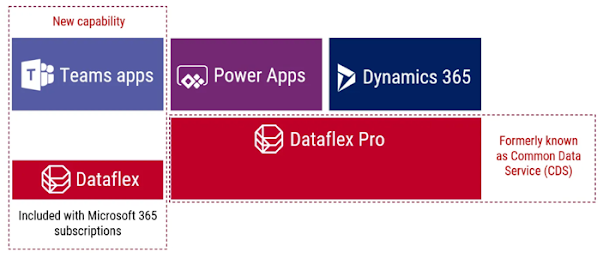
Microsoft recently announced a new service called Dataflex. In short, it is a data platform for low-code apps that can be built right within Microsoft Teams. This is a brand new commercial offering and it comes bundled with every subscription of Office 365 / Microsoft 365 that includes the right to use Teams. Microsoft Dataflex delivers a built-in, low-code data platform for Teams, and provides relational data storage, rich data types, enterprise grade governance, and one-click solution deployment. Microsoft Dataflex enables everyone to easily build and deploy apps and intelligent chatbots in Teams with Microsoft Power Apps and Microsoft Power Virtual Agents.  Extension of DataFlex Pro. So what is Dataflex Pro? At the same time, Dataflex Pro became the new name for what used to be called Common Data Service (CDS). For those who are more familiar with Power Platform technology, you’ll know that CDS has served as the foundation for building your custom Power Apps as w...

Business process development with Power Apps and MS Teams

While using legacy systems, users previously had to jump between several different systems through a series of bookmarks or company portals. This constant switching can be incredibly disruptive. According to a June 2015 UC Irvine study, “The Cost of Interrupted Work: More Speed and Stress,” it can take upwards of 23 minutes for a person to regain productivity after such an interruption. Microsoft Teams is the hub for teamwork Microsoft believes Microsoft Teams is the home for the modern workplace of the future. Out of the box, Microsoft Teams brings together the most common tasks that employees need under a single roof, such as chats, meetings, calls, and the productivity suite of Office 365. By combining these together into a sole product, employees can avoid having to constantly switch between various contexts. Instead, they can spend their time within a single team or channel that effortlessly brings together all the relevant information in-context. The Microsoft Power Platfor...